
If you are forming a company, buying real estate or starting operations in Panama, hiring a business lawyer is not optional: Panamanian law reserves certain functions for licensed attorneys. Article 2 of Law 2 of 2011 defines the resident agent, a figure every Panamanian company must appoint, as a lawyer or law firm providing its services as such. This guide, for U.S. and Canadian founders and investors, explains what a business lawyer in Panama does, how to confirm the lawyer is licensed, which obligations should be managed for you, and what to ask before signing.
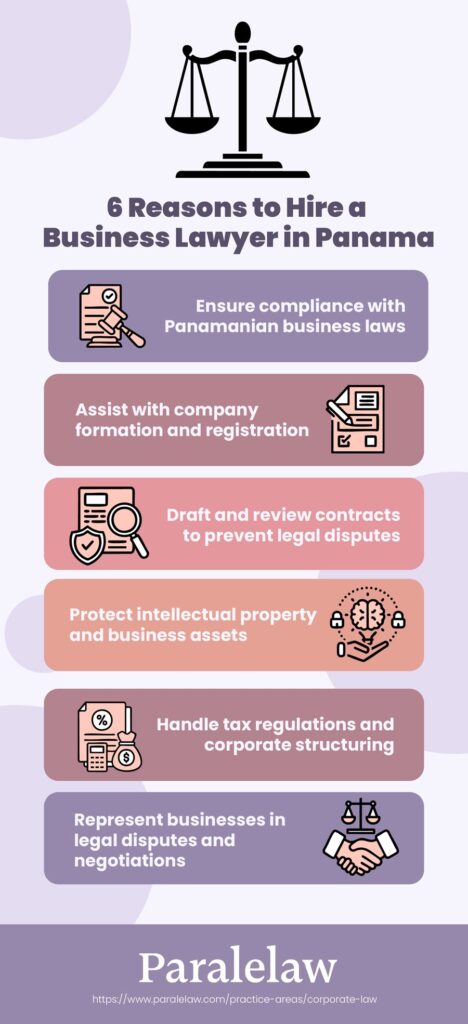
What a business lawyer in Panama actually does
Some of it will look familiar: contracts, corporate structuring, disputes, and support on asset purchases and sales.
The other part can only be done by a lawyer. As resident agent, the firm is required by article 3 of Law 2 of 2011 to identify the client and verify that identity against reliable and independent sources, to know why the entity was created, and to cooperate with the authorities. The documentation is kept for five years after the relationship ends (article 10).
Article 24 of Law 23 of 2015 reinforces the point: lawyers fall under supervision when, on behalf of a client, they form or manage legal entities, act as resident agent, handle client funds or accounts, or take part in the purchase and sale of real estate or of companies.
How to confirm your lawyer is licensed
In Panama the licence to practise is the certificado de idoneidad, issued by the Fourth Chamber of General Affairs of the Supreme Court of Justice. The governing framework is Law 350 of 2022, which replaced Law 9 of 1984. There is no state or provincial bar roll to search as in the U.S. and Canada, so the idoneidad is the reference point.
Since 2023 the Fourth Chamber issues lawyer ID cards with a verifiable QR code. Asking for the idoneidad number and the card takes thirty seconds, and it is the one check that separates a lawyer from someone who merely presents as one.
The obligations your lawyer should be managing
Most problems start at maintenance, not incorporation. Your lawyer should have these recurring obligations on a calendar:
| Obligation | Deadline | Legal basis |
|---|---|---|
| Register the ultimate beneficial owner with the Superintendency of Non-Financial Subjects | 15 business days from incorporation; 5 business days to report a change | Law 129 of 2020 |
| Deliver the accounting records to the resident agent and keep them | Before April 30 each year; minimum retention of five years | Law 52 of 2016 |
| Pay the annual single fee (tasa única) for the legal entity | Annual | Article 318-A of the Tax Code |
| Obtain the Notice of Operation (Aviso de Operación) | Before starting commercial or industrial activity | Law 5 of 2007 |
Non-compliance carries penalties: Law 129 of 2020 provides fines of B/.1,000 to B/.50,000 for each unregistered legal entity. Article 318-A of the Tax Code also blocks registration of corporate acts at the Public Registry while the company is in arrears, so a careless firm can leave you unable to transfer shares or change directors.
What to ask before you hire
- What is your idoneidad number, and which attorney, by name, will be responsible for the file?
- Will the firm act as resident agent? If not, who will, and at what annual cost?
- How do you bill? Flat fee, hourly rate or retainer, and which third-party costs (notary, Public Registry, fees) are billed separately?
- Who controls the annual calendar for beneficial ownership, accounting records and the tasa única?
- Do you have a conflict of interest with my counterparty, local partner or competitor?
Common mistakes when choosing a lawyer in Panama
Confusing an incorporation agent with legal advice. Forming the company is fast; deciding which structure suits you and how control is allocated is not. If your only deliverable is a folder of documents, you got paperwork, not advice.
Assuming a Panamanian company pays no tax. Panama applies a territorial system: article 694 of the Tax Code taxes income produced within national territory, regardless of where it is received. If your operation generates Panamanian source income, it is taxable. Panama’s system also says nothing about your obligations at home: U.S. citizens and residents are taxed on worldwide income and usually have separate reporting duties for foreign accounts and companies, and Canadian residents have their own rules. Confirm the specifics with a tax adviser at home.
Hiring staff without checking the labor quotas. Article 17 of the Labor Code requires that at least 90% of ordinary employees be Panamanian, or foreign nationals with a Panamanian spouse or ten years of residence, and caps specialized or technical foreign staff at 15% of the total. Settle this with labor law advice before your first hire.
Frequently asked questions
Is a lawyer mandatory to open a company in Panama?
In practice, yes. Every Panamanian company appoints a resident agent, and article 2 of Law 2 of 2011 requires that agent to be a lawyer or law firm.
Can a foreign lawyer represent me in Panama?
Your U.S. or Canadian counsel can advise on their own jurisdiction’s law, but acting before Panamanian authorities and signing as resident agent requires a Panamanian idoneidad.
How much does a business lawyer in Panama cost?
It depends on the model: flat fee, hourly rate or monthly retainer. Ask in writing what is included and what is billed separately.
Can I change my resident agent?
Yes. It is a corporate change recorded at the Public Registry, and the incoming agent takes over due diligence and the beneficial ownership filing.
Do I need a lawyer if my company does not operate in Panama?
Yes. Even with no local operations, the company keeps a resident agent, a beneficial ownership filing and accounting records under Law 52 of 2016.
The next step
Choosing a lawyer in Panama comes down to three checks: a current idoneidad, a written commitment to your annual calendar, and an explanation of the structure before anyone sells you a package. At Paralelaw we work with foreign investors from company formation in Panama through annual maintenance.